
Should I Repair or Replace My Refrigerator in Olathe, KS?
Should you repair or replace your refrigerator? It’s the #1 question we hear — and we answer it honestly, even when the answer costs us a job. This framework gives you math, not guesswork: the 50% rule, age thresholds, energy costs, and the failure patterns that tip the decision. (913) 412-0164. We’re available 24/7, and if the same problem returns within 3 days of our repair, we come back and re-repair it free.
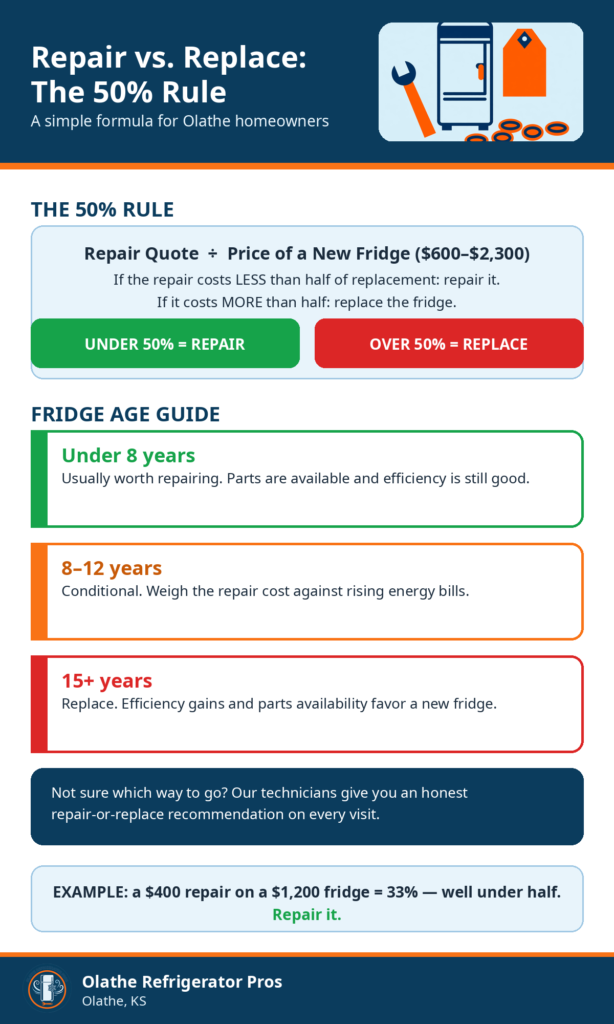
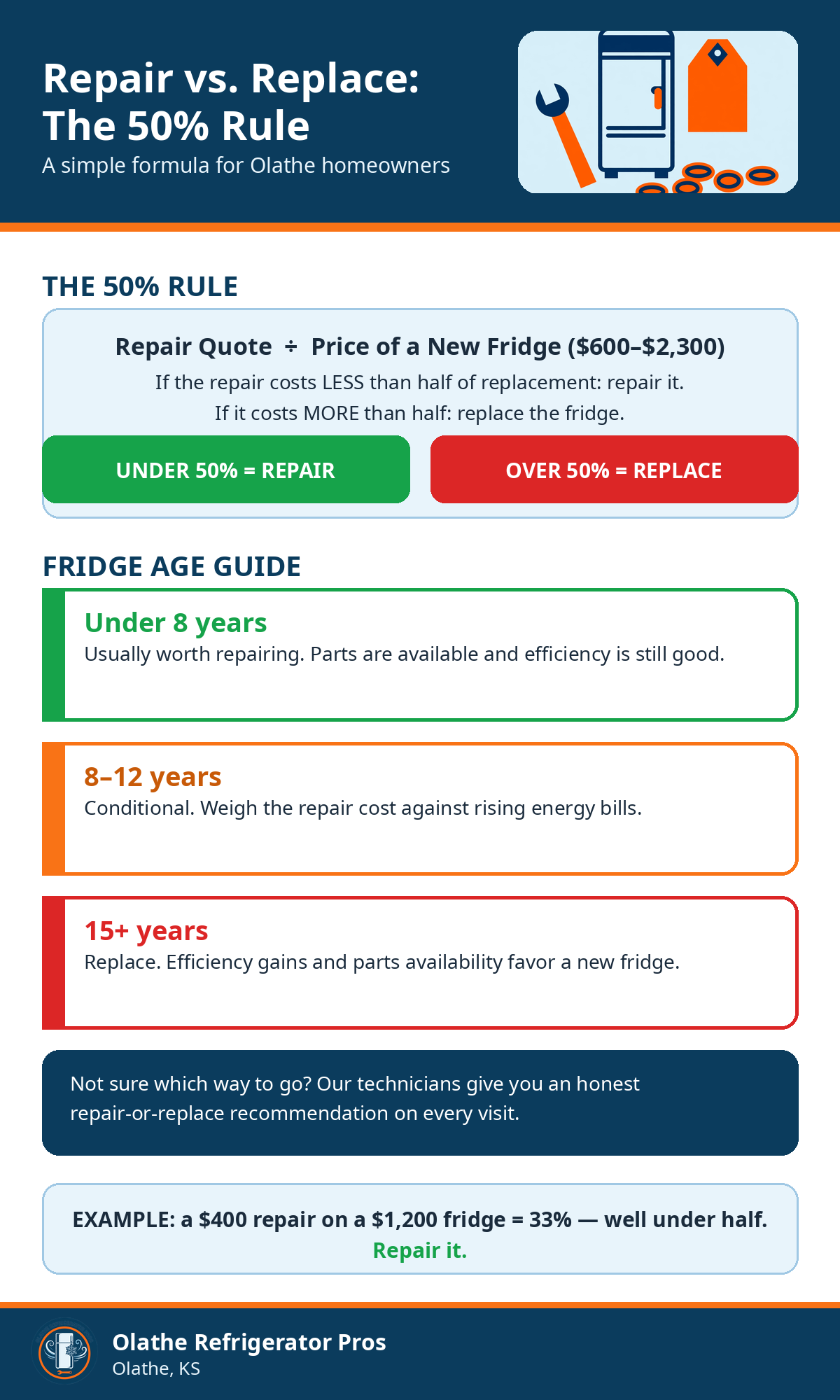
Repair it if the repair costs less than half the price of a comparable new refrigerator, and replace it if it costs more. That is the 50% rule we use, and we give you an honest diagnosis and an upfront quote before any work starts. Call (913) 412-0164 and we will talk through your specific fridge and quote.
What Is the 50% Rule for Refrigerator Repair?
Start here — this single rule resolves most cases:
If the repair costs more than 50% of a comparable new refrigerator, replacement usually wins.
Examples:
– $250 ice maker repair on a $1,400 fridge → repair (18% — easy call)
– $300 defrost system repair on a $1,200 fridge → repair (25%)
– $850 control board on a $1,600 fridge → borderline (53% — keep reading)
– $1,100 compressor on a $1,400 fridge → replace (79% — clear call)
The 50% rule works because it captures the economics: you’re buying remaining lifespan. A repair costing half the price of new only makes sense if the fridge has more than half its life left — which brings us to age.
But the rule isn’t the whole story. A 45% repair on a fridge with three prior failures is worse than a 55% repair on a 6-year-old unit with a clean history. Apply the rule first, then adjust with the factors below.
How do I apply the 50% rule?
Divide the repair quote by the price of a comparable new refrigerator. Over 0.5 (50%) → replacement usually wins. Under 0.5 → repair usually wins. Then adjust for age, energy costs, and failure history using the framework below.
How Does Refrigerator Age Affect the Decision?
Age doesn’t decide alone, but it frames everything:
Under 8 years: repair almost always wins. The fridge has most of its life left; even a $500–$800 repair is buying years of service. Exception: repeated sealed-system failures (a lemon pattern).
8–12 years: the judgment zone. Apply the 50% rule strictly, and weigh the failed part. A $200 defrost repair at year 10? Fix it. A $900 sealed-system job at year 11? Replace.
12–15 years: lean replace for anything over $300–$400. The fridge is past its design life; every repair buys less remaining time, and the next failure is already scheduled.
Over 15 years: replace for any major failure. Minor fixes (gaskets, thermostats under $200) can still make sense to bridge you to a planned purchase — but don’t invest serious money.
Why age matters physically: compressors wear, sealed-system joints fatigue, insulation degrades, and parts for older models get scarce and expensive. An old fridge isn’t just old — it’s a platform where every component is simultaneously near end-of-life.
Is it worth fixing a refrigerator over 10 years old?
Not automatically — it depends on the failure. A $200 defrost repair on a 12-year-old fridge is worth doing; a $1,100 compressor on the same fridge isn’t. Age is one input; the failed part’s cost relative to replacement is the deciding factor.
What Hidden Costs Should I Factor In?
The sticker price isn’t the total cost. Factor these:
Energy costs. A 15-year-old refrigerator can use twice the electricity of a modern equivalent — that’s $100–$200+ extra per year on your utility bill, every year. Over 5 years, an inefficient old fridge can cost you $500–$1,000 more to run than a new one. When the 50% rule is borderline, energy savings tip it toward replace.
Failure history. One failed ice maker in 8 years is normal. A compressor at year 6, a board at year 7, and a leak at year 8 is a pattern — the fridge is telling you its systems are failing in sequence. Don’t buy one more repair on a cascade.
Food-spoilage risk. An unreliable fridge that fails repeatedly costs you $200–$400 in spoiled groceries per incident. Two spoilage events can exceed the price difference between repairing and replacing.
Features and fit. If the old fridge never fit your kitchen right, lacked the ice/water features you want, or runs loud enough to hear from the living room, replacement buys quality of life too — legitimate factors, honestly weighed.
Environmental angle. Repairing keeps a large appliance out of the landfill and avoids manufacturing a new one. When the math is close, repair is the greener choice — and we’re happy to say so.
Do energy costs really matter in this decision?
Yes — significantly. A 15-year-old fridge can cost $100–$200+ more per year to run than a modern equivalent. Over 5 years that’s $500–$1,000. When the 50% rule is borderline, energy costs usually tip the decision toward replacement.
Which Failures Mean Replace, and Which Mean Repair?
Some failures scream “replace” regardless of the math:
– Compressor failure on a 10+ year unit ($700–$1,250 repair on a dying platform)
– Repeated sealed-system failures — the system is compromised; the next leak is coming
– Refrigerant leak in an aging unit — especially with R-134a systems being phased in favor of newer refrigerants
– Structural issues — rusted cabinets, deteriorated insulation, failing door alignment that gaskets can’t fix
– Obsolete parts — when the control board hasn’t been manufactured in 8 years and used ones cost $400
And the clear “repair” signals: failed ice maker, fan motors, defrost components, gaskets, relays, valves, thermostats — the $125–$500 fixes that return years of service on a fundamentally sound fridge.
Brand-specific notes: LG linear compressors have a documented 3–6 year failure pattern ($850–$1,100+ quotes) — on an LG in that window, get the full diagnosis before deciding. Samsung ice maker freeze-ups are a known defect pattern but usually a $200–$400 fix, not a replace signal. See our LG and Samsung pages.
When we diagnose your fridge, we give you this analysis unprompted — including when the answer is “buy new.” Call (913) 412-0164.
My compressor failed — replace the fridge?
Usually yes — replace. A compressor job runs $700–$1,250, and on a 10+ year unit you’re investing heavily in a platform near end-of-life. Under 8 years with no prior failures, repair can still win. We’ll diagnose and show you the math either way.
What’s the Step-by-Step Decision Process?
Walk through this in order:
1. Get the real diagnosis. Not a guess — a tested, confirmed failed component with a written quote. (That’s our process.)
2. Apply the 50% rule. Repair quote ÷ comparable new fridge price. Over half → lean replace.
3. Check the age bracket. Under 8: repair. 8–12: judge. 12+: lean replace for anything major.
4. Add energy math. Old + inefficient + borderline quote = replace.
5. Review failure history. Cascade of failures = replace, even if this one repair is cheap.
6. Decide without pressure. We’ll give you the analysis and leave the decision to you — no sales pitch either way.
Final price is always confirmed after diagnosis — the ranges in our cost guide help you budget, but your technician quotes your exact situation before you decide anything.
Still torn? Call (913) 412-0164. We’ll talk through your specific fridge, your specific quote, and give you the answer we’d give our own family.
Can you just tell me what to do?
Get a real diagnosis with a written quote, apply the 50% rule, check the age bracket, add energy costs, review failure history — then decide without pressure. We’ll walk you through it on the phone or on-site: (913) 412-0164.
Frequently Asked Questions
Is it worth repairing my refrigerator, or should I just buy a new one?
The #1 asked question in refrigerator repair. Use the 50% rule: if the repair costs more than half of a comparable new refrigerator, replacement usually wins. Then factor age (over 10–15 years leans replace), energy costs, and failure history. We’ll give you an honest answer even when it’s ‘buy new.’
What is the 50% rule for refrigerator repair?
If a repair costs more than 50% of the price of a comparable new refrigerator, replacement is usually the smarter money. Example: a $900 compressor job on a fridge you could replace for $1,400 = replace. A $250 ice maker fix on the same fridge = repair.
Is it worth fixing a refrigerator that is over 10 years old?
It depends on the failure, not just the age. A 12-year-old fridge with a $200 defrost repair is worth fixing; the same fridge with a $1,100 compressor failure usually isn’t. Age is one factor — the failed part and its cost matter more.
Which refrigerator brands break down the least?
On reliability data, Whirlpool and KitchenAid show the lowest failure rates; Samsung the highest (driven largely by ice maker issues). But brand reliability matters less than your specific fridge’s age, failure history, and the current repair cost.
What are the clearest signs I should replace instead of repair?
Repeated sealed-system failures, a repair exceeding half of replacement cost, age over 15 years with a major failure, or rust/structural deterioration. Any one of these is a strong replace signal; two together is decisive.
My compressor failed — should I replace the fridge?
Sometimes — especially if the fridge is under 10 years old and otherwise sound. Sealed-system work runs $200–$1,250 depending on the job. But on an older unit with prior failures, it’s usually the signal to replace. We’ll diagnose and give you the straight math.
How do I apply the 50% rule?
Divide the repair quote by the price of a comparable new refrigerator. Over 0.5, or 50%, replacement usually wins. Under that, repair usually wins. We give you a real diagnosis with a written quote first, so you can do the math on your exact situation.
How does refrigerator age affect the decision?
Under 8 years, repair almost always wins. At 8 to 12 years, it is the judgment zone, apply the 50% rule strictly and weigh the failed part. At 12 to 15 years, lean replace for anything over $300 to $400. Over 15 years, replace for any major failure, though minor fixes under $200 can still make sense.
What hidden costs should I factor in?
Energy costs first: a 15-year-old refrigerator can use twice the electricity of a modern equivalent, $100-$200+ more per year. Then failure history, a fridge that has failed repeatedly is likely to fail again, and food spoilage, $200-$400 in spoiled groceries per incident.
Do energy costs really matter in this decision?
Yes, significantly. A 15-year-old fridge can cost $100-$200+ more per year to run than a modern equivalent. That extra running cost should be added to any repair quote, and it can tip a borderline repair toward replacement.