
What Refrigerator Temperature Setting Is Right?
What temperature should your refrigerator be? The FDA says 37–40°F for the fridge and 0°F for the freezer — but the right refrigerator temperature setting is only half the story. Where you place the thermometer, how full the fridge is, and whether the unit actually holds its setting matter just as much. This guide covers it all, from daily habits to the mechanical failures that let temperature drift. We are Olathe Refrigerator Pros, and our technicians repair cooling problems across Olathe, KS (ZIPs 66061 and 66062) around the clock. If your fridge will not hold temperature, call Call (913) 412-0164.
What Is the Correct Refrigerator Temperature Setting?
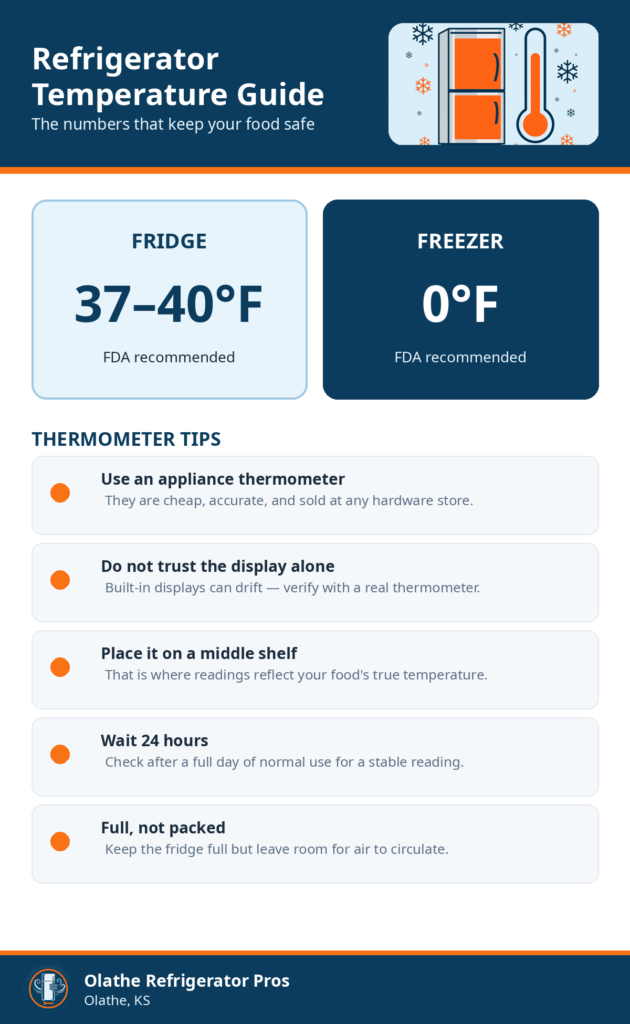
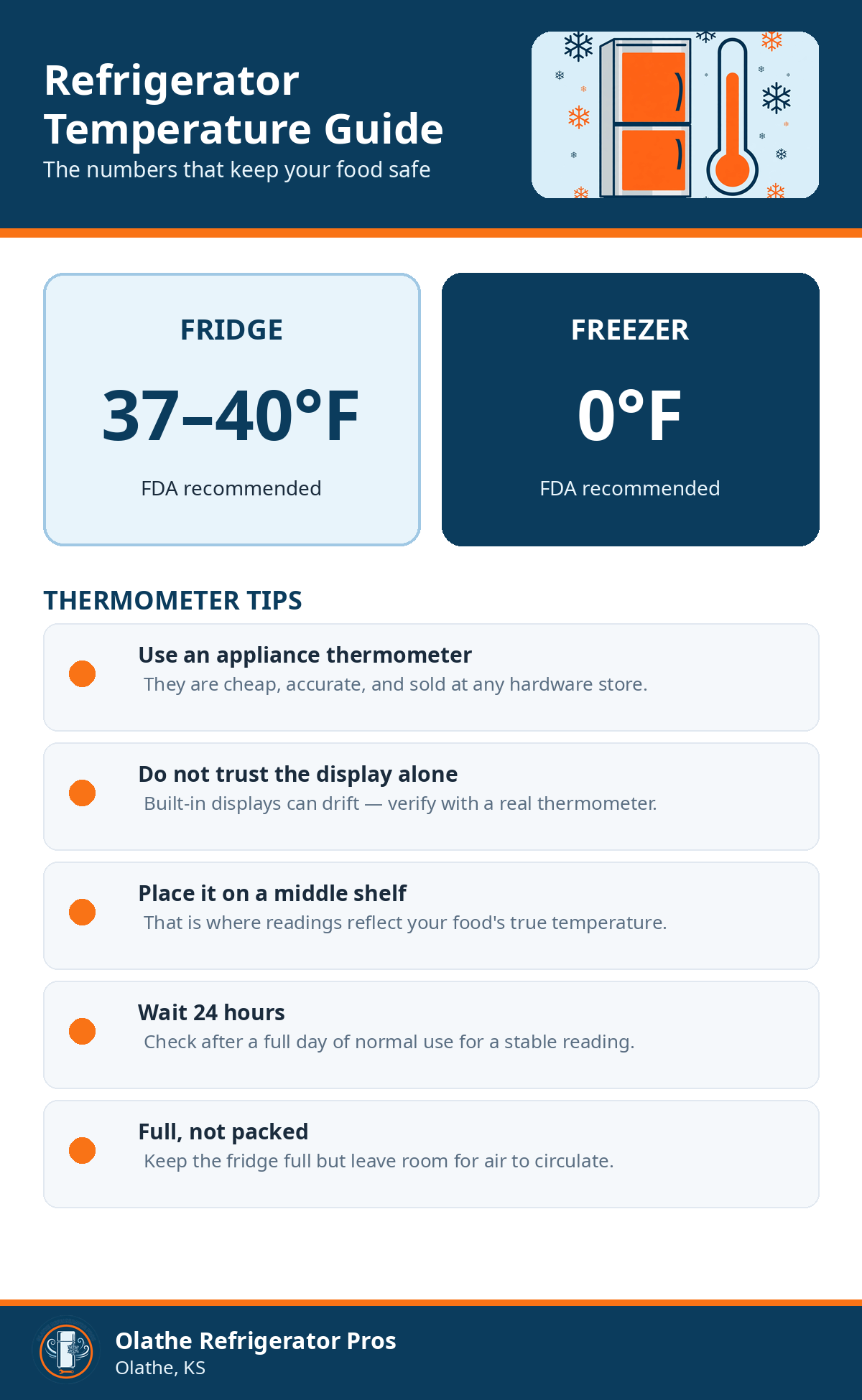
The FDA recommends a refrigerator temperature setting of 37–40°F, with the freezer at 0°F. We tell Olathe homeowners to aim for 37°F in the fridge: it keeps food safely below the 40°F danger-zone threshold (where bacteria multiply rapidly) while staying safely above freezing so lettuce and milk do not ice over. The freezer’s 0°F target stops bacterial growth entirely and preserves food quality long-term. These numbers come from the FDA’s food-safety guidance, not from us — they are the standard every food-safety agency in the country uses.
Why Do We Recommend 37°F Instead of 40°F?
37°F is our recommended set point because it gives you a 3-degree buffer. Compressor cycles, door openings, and warm grocery loads all cause small temperature swings; starting at 37°F keeps those swings below 40°F. Set to 40°F exactly and a heavy grocery run can push the cabinet into the danger zone for an hour or two. That margin matters most for households with pregnant women, elderly family members, or immunocompromised people — groups for whom foodborne illness hits hardest.
Does Every Shelf Really Stay at the Set Temperature?
Every compartment is different. The middle shelves hold the steadiest temperature, the door shelves are the warmest (milk belongs inside, not in the door), and the bottom drawers run coolest. A fridge ‘set to 37°F’ can read 42°F on the door shelf and 34°F at the back of the bottom shelf. That is why our technicians always verify with an independent thermometer during a service call rather than trusting the dial or display. If your fridge cannot hold 37°F on the middle shelf, something mechanical is wrong — see our fridge not cooling guide for symptoms.
How Do You Check the Real Temperature Inside Your Fridge?
The air inside your fridge swings temperature every time the compressor cycles or the door opens, so a thermometer dangling in air gives jumpy readings. The pro trick: put an inexpensive appliance thermometer in a small glass of water on the middle shelf and wait 24 hours. The water’s temperature reflects what your food actually experiences. Check it at the same time each day for a few days to see the real pattern. If readings hover at 37–40°F, your fridge is doing its job. If they climb past 40°F regularly, read our food safety for a broken fridge guide immediately — you have a food-safety situation, not just a comfort problem.
Can the Display Lie to You? Yes — Here Is How
Yes — this is one of the most common surprises we find on service calls. A failed thermistor or a control board with a bad relay can display 37°F while the cabinet sits at 50°F or higher. If your food tells a different story than the display — milk souring early, leftovers going off fast, produce wilting — trust the food, not the screen. An independent thermometer costs less than the groceries you will lose trusting a lying display. When you call us, our technicians test the sensors with a multimeter and replace the failed part on the spot in most cases.
What Is the Best Thermometer to Use?
Appliance thermometers are cheap and accurate. Infrared ‘point and shoot’ thermometers read surfaces, not food temperature, so they are useful for spotting warm zones on shelves but not for food-safety decisions. Built-in fridge thermometers on high-end models are better than nothing but share the sensor with the control system — if the sensor fails, the display fails with it. The $5 glass-of-water method with a simple dial thermometer remains the most reliable home test. We check readings this way ourselves during refrigerator maintenance tune-ups.
Why Will Your Fridge Not Hold Its Setting?
When a fridge will not hold its temperature setting, the cause is almost always mechanical. The usual suspects: a compressor losing efficiency (runs constantly, never pulls down), a failing thermostat or thermistor that misreads cabinet temperature, a control board stuck in a defrost loop, a refrigerant leak starving the evaporator, or condenser coils so packed with dust and pet hair that heat cannot escape the system. In Olathe, we also see refrigerant-related strain spike during July’s heat-index weeks of 105–110°F, when the system has to move far more heat out of the cabinet. Worn door gaskets are the sneaky one — a seal that looks fine but leaks warm air forces the compressor to run overtime and still lose ground.
Are Dirty Condenser Coils the Hidden Culprit?
Dirty condenser coils are the number one preventable cause we see in Olathe homes. The coils sit on the back or underneath the fridge and shed the heat the system pumps out of the cabinet. When they are matted with dust, heat cannot escape, so the fridge runs longer, uses more electricity, and still cools poorly. Pull the fridge out twice a year and vacuum the coils with a brush attachment. Homes with shedding pets may need quarterly cleaning. If cleaning does not fix it, the problem is deeper — a failing compressor, low refrigerant, or a bad control board — and it is time to call Call (913) 412-0164.
Could Worn Door Gaskets Be Letting Warm Air In?
A gasket that does not seal is an open window into your fridge. Test it with the dollar-bill trick: close the door on a dollar bill and pull. If it slides out easily anywhere around the perimeter, warm air is leaking in. Cracked, torn, or flattened gaskets need replacement — it is one of the most cost-effective repairs we do. Our door gasket replacement service restores the seal in a single visit, and it often drops a struggling fridge back to a steady 37°F.
How Do Kansas Seasons and Daily Habits Affect Fridge Temperature?
Olathe summers and winters both challenge your fridge’s temperature control. In July, with highs of 88–90°F and heat-index days hitting 105–110°F, the compressor works much harder to move heat out of the cabinet — especially if the fridge sits in a hot garage or near a sunny window. You may need to nudge the setting a degree colder and, more importantly, verify the actual temperature rather than trusting the dial. In winter, the opposite problem hits garage fridges: when the unheated garage drops below about 40°F, the thermostat thinks the fridge is ‘cold enough’ and the compressor never cycles — while the freezer section thaws. We cover that cold-weather trap fully in our winter garage fridge guide.
What Daily Habits Push Your Fridge Temperature Up?
Daily habits move the needle more than most people think. Loading a week’s worth of warm groceries raises cabinet temperature for hours — give the fridge time to recover and avoid cramming items against the back wall where they block airflow. A fridge that is too empty actually holds temperature worse: cold food acts as thermal mass that stabilizes the cabinet. Keep it reasonably stocked, leave space between items for air circulation, and let hot leftovers cool on the counter for a short time before refrigerating (within 2 hours, per USDA rules). Letting the door hang open while you decide what to eat is the classic temperature killer.
Just Moved In? Why New Fridges Deserve a Temperature Check Too
A brand-new fridge settles into its set temperature within 24 hours. If you have just moved into an Olathe home — say in Cedar Creek, Stonebridge, or near Lake Olathe — and the fridge never quite reaches 37°F, do not assume it ‘needs time.’ Check with a thermometer after a full day. New-to-you used fridges from a move or a rental turnover deserve the same test. If the unit cannot hold temperature from day one, call us before the warranty or return window closes. Our technicians service all major brands — see our brand pages, from GE to Samsung to LG.
When Should You Call Us About Temperature Problems?
If your refrigerator cannot hold 37–40°F no matter what the dial says, you are looking at a repair, not a settings tweak — and every day you wait is a food-safety risk. We diagnose the real cause with professional instruments: refrigerant pressures, compressor amp draw, sensor readings, and control-board output. Most temperature failures trace to a short list of parts — thermostats, thermistors, start relays, capacitors, control boards, or door gaskets — and we carry the common ones on the truck for same-day fixes. Olathe Refrigerator Pros is open 24/7 across Olathe, KS. Call Call (913) 412-0164 and our technicians will get your fridge holding temperature again. If the same problem returns within 3 days of our repair, we come back and re-repair it free. Curious what a fix typically costs? See our refrigerator repair cost guide — final price is always confirmed after diagnosis.
How Urgent Is Your Temperature Problem?
If the cabinet is holding in the 40s and climbing, that is urgent — your food is entering the danger zone. If the freezer is fine but the fridge section is warm, that points to a damper or defrost issue and needs service but is slightly less time-critical. A fridge that runs constantly without cycling off is working itself toward a compressor failure — call before the compressor dies, because a compressor replacement costs far more than the relay or thermostat that is overworking it. When in doubt, call: we would rather tell you it is a dirty coil you can clean yourself than see you lose a fridge full of food.
Frequently Asked Questions
What is the ideal refrigerator temperature?
The FDA recommends 37–40°F for the refrigerator compartment and 0°F for the freezer. 37°F is the sweet spot: cold enough to slow bacterial growth with margin above freezing.
Where is the best place to put a refrigerator thermometer?
Put an appliance thermometer in a glass of water on the middle shelf and check it after 24 hours — water gives a truer reading than air, which swings every time the door opens.
Should you change the setting between summer and winter?
Yes — heat makes compressors work harder, and cold surroundings confuse the thermostat. Set the fridge a degree or two colder in summer and monitor the actual temperature rather than trusting the dial.
My fridge display says 37°F but food spoils early — why?
Do not assume the display is accurate. A failed sensor or stuck control board can show 37°F while the cabinet sits at 50°F. Verify with an independent thermometer.
Why does my refrigerator run constantly in summer?
Often, yes — the compressor is working overtime because of dirty condenser coils, weak door seals, or low refrigerant. Clean the coils first; if it still runs constantly, call us at (913) 412-0164 for diagnosis.
Can you come out today if my fridge will not hold temperature?
Yes, absolutely — we are open 24/7 across Olathe, KS (ZIPs 66061 and 66062). Call (913) 412-0164 any time. Our warranty: if the same problem returns within 3 days of our repair, we come back and re-repair it free.