
Refrigerator Not Cooling? Repair in Olathe, KS
A warm fridge is an emergency. Food starts becoming unsafe after about four hours without cooling, so if you need refrigerator not cooling repair olathe, do not wait. We are Olathe Refrigerator Pros — our own technicians diagnose warm fridges across Olathe and Johnson County every day, and most are fixed the same visit. If the same problem returns within 3 days of our repair, we come back and re-repair it free. Call (913) 412-0164 now — we answer 24/7.

Why Is My Refrigerator Not Cooling but the Freezer Is Cold?
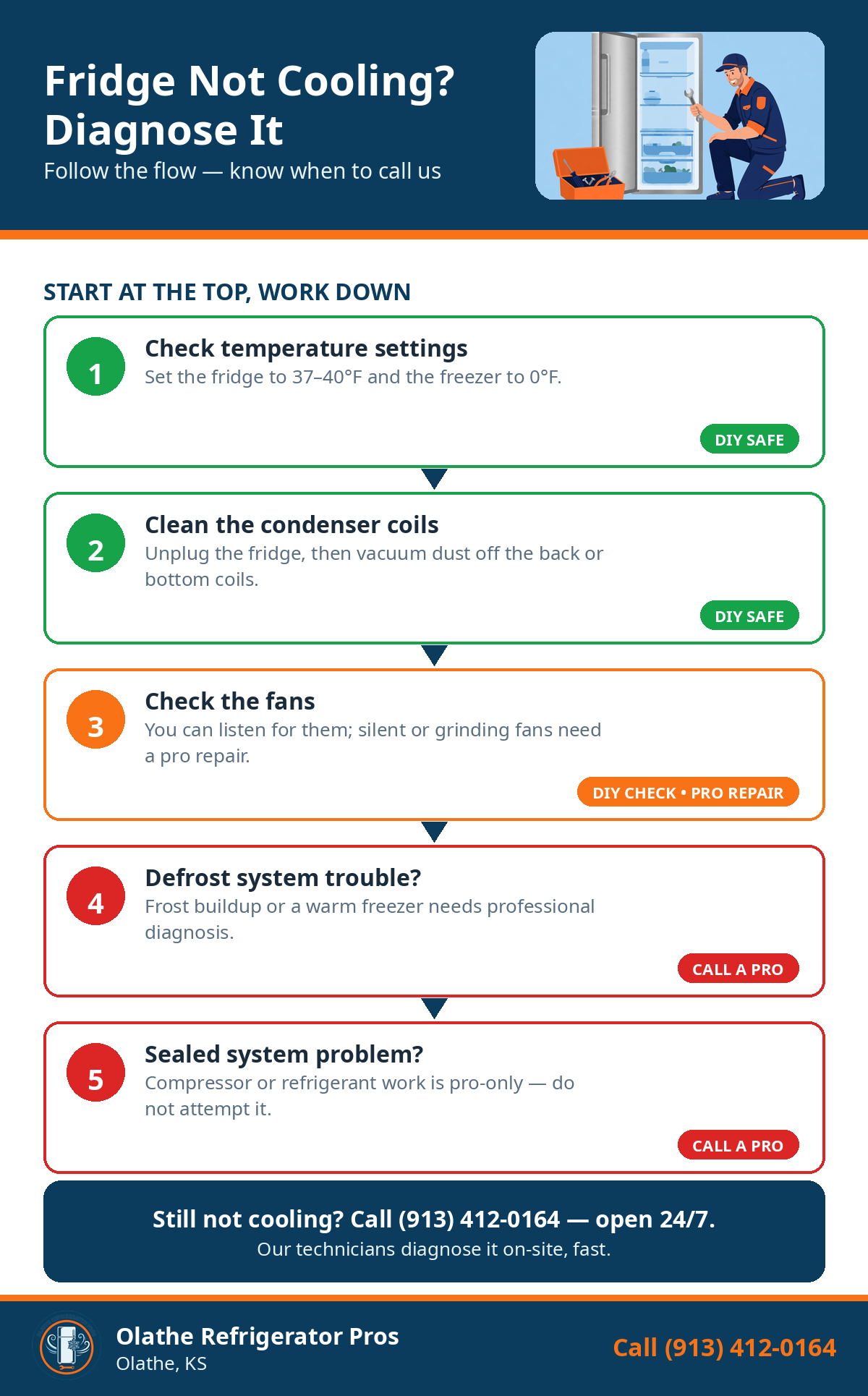
A fridge that will not cool while the freezer still works is one of the most common calls we get, and it has a specific set of causes. The #1 culprit is a failed defrost system: frost builds up on the evaporator coils until air cannot flow through them, so no cold air reaches the fresh-food section. Next is a dead evaporator fan motor — the fan that blows cold air from the freezer into the fridge. A stuck air damper (the little door that meters cold air into the fridge) causes the same symptom. Less often, a failed thermistor or main control board misreads temperatures and never calls for cooling. The compressor is rarely the cause when the freezer is still cold — if the compressor were dead, the freezer would warm up too. Our technicians test in order of likelihood, cheapest first, so you are not paying for sealed-system work when the real problem is a $200 fan.
What Is the Evaporator Fan?
The evaporator fan is the small fan inside the freezer that blows air across the cold evaporator coils and pushes it through ducts into the fresh-food section. When it dies, the freezer can stay cold (cold air just sits there) while the fridge warms up because no air is being moved. Symptoms: the fridge is warm, the freezer is fine, and you do not hear the fan running when you open the freezer door and press the door switch. It is a $200 to $300 repair and one of the most common fixes we do.
Why Is My Fridge Running but Not Getting Cold?
Cooling fades for a handful of reasons, and most of them are not the compressor. Dirty condenser coils are the top preventable cause — when the coils cannot shed heat, the whole system runs hot and weak, and Olathe’s summer heat-index weeks make it worse. A failed defrost system ices over the evaporator coils and chokes off airflow. Worn door gaskets let warm, humid air pour in faster than the system can remove it. A failed start relay or control board can stop the compressor from running at all. And true sealed-system failures — a weak compressor or a refrigerant leak — cause a slow, steady loss of cooling over days or weeks. Each cause has a distinct fingerprint, which is why proper diagnosis matters more than guessing. Our full process is on our main refrigerator repair page.
What Temperature Should My Fridge Be?
37 to 40°F for the fresh-food section and 0°F for the freezer — those are the FDA recommendations, and they are also what your fridge is designed around. If your fridge is set to 37°F but a thermometer reads 50°F, the setting is not the problem; something in the cooling chain has failed. Put a real thermometer in a glass of water in the middle shelf and check it after a few hours — built-in displays can lie when the thermistor is bad.
How Do Our Technicians Diagnose a Warm Fridge?
Our technicians work through a fixed sequence. First, we verify temperatures with our own thermometers and check the settings, breaker, and door seals — the simple stuff first. Then we listen and feel: is the compressor running, are the fans turning, is the condenser hot? Next we inspect the evaporator coils for frost patterns — a fully frosted coil means defrost failure; a partially frosted coil means a sealed-system problem. We test the defrost heater, defrost thermostat, and thermistor with a multimeter, check the evaporator and condenser fan motors, and test the start relay and control board outputs. The sealed system gets tested last, because it is the least likely cause and the most expensive fix. You get a written estimate before any work begins, and the final price is confirmed after diagnosis. Typical warm-fridge repairs run $150 to $400; see our cost guide for details.
Why Test the Sealed System Last?
Because in our experience it is the cause less than 10% of the time on a warm-fridge call, and sealed-system diagnosis is the most expensive kind. Testing the defrost system, fans, damper, thermistor, and board first means most customers get a $200 to $350 fix instead of a $700+ sealed-system quote. We only open the sealed system when the evidence — the frost pattern on the coils — tells us the problem is really there.
When Is a Warm Fridge an Emergency?
Call us immediately if the fridge is above 40°F and climbing, if there is any burning smell, or if the compressor is clicking repeatedly (unplug it first). Call the same day if the fridge is holding in the 40s but not recovering, or if the freezer is starting to warm too — you are on the USDA 4-hour food-safety clock with the door closed, less if the door keeps getting opened. It can wait until morning only if the fridge is still at 40°F or below and holding steady. When in doubt, call (913) 412-0164 — we would rather talk you through it at midnight than have you throw out $300 of groceries. Our emergency refrigerator repair covers exactly this.
How Long Will Food Stay Safe in a Fridge That’s Not Cooling?
About 4 hours with the door kept closed, per the USDA. After that, perishables — meat, dairy, eggs, leftovers — must be discarded; ‘when in doubt, throw it out’ is the rule. A full freezer holds temperature longer, up to 48 hours if unopened. Move the most valuable items to a cooler with ice while you wait for us, and keep the fridge door shut — every opening dumps the remaining cold air.
What Are the Dangers of Running a Fridge That Won’t Cool?
Running a fridge that cannot cool is harder on it than you might think. The compressor runs nonstop trying to reach a temperature it can never hit, which overheats it and can turn a $200 fan repair into a $900 compressor replacement. Food spoilage is the obvious cost — a full fridge of groceries is worth more than most repairs. Warm, moist conditions also grow mold fast, especially in the drip pan and door gaskets, and mold in a fridge can make you sick. There is also a less obvious danger: if the cause is electrical — a failing control board or shorted start relay — continued operation risks overheating wiring. Unplug the fridge if you smell anything burning or hear repeated clicking, and call us.
Can Mold in My Refrigerator Make Me Sick?
Yes. Mold loves warm, damp fridge interiors, and some molds produce toxins that survive on surfaces even after wiping. If your fridge sat warm for more than a day, we recommend a full sanitizing clean once it is cooling again — and if mold has gotten into the gaskets or drip pan, those parts may need replacing. Our mold guidance covers safe cleanup.
How Can You Prevent Warm-Fridge Breakdowns?
Clean the condenser coils every 6 months — unplug the fridge first, then vacuum with a brush attachment. It is the single highest-value maintenance task in refrigeration, and it is safe to do yourself. Check the door seals with the dollar-bill test twice a year. Keep the fridge 2 to 3 inches from the wall so heat can escape, and do not push it flush into a tight alcove. Replace the water filter every 6 months if you have a dispenser. Put a surge protector on the fridge outlet before spring storm season — surges kill control boards and start relays, and both cause warm-fridge calls. And keep the freezer reasonably full; thermal mass means fewer, shorter cooling cycles and less work for every component. Our maintenance tune-up covers all of this professionally once a year.
Can I Clean the Condenser Coils Myself?
Yes — with the fridge unplugged, vacuuming the condenser coils is completely safe and takes ten minutes. Pull the fridge out, remove the lower back panel or front grille, and vacuum the coils and the fan area. Do this every 6 months, and every 3 to 4 months if you have shedding pets. Never touch electrical connections, never open the sealed system, and never add refrigerant yourself — federal law requires EPA 608 certification for that.
Is It Worth Repairing, or Should You Just Buy a New One?
Use the 50% rule: if the repair costs less than half of a comparable new fridge, repair it. Most warm-fridge fixes — fan motors ($200 to $300), defrost parts ($200 to $350), thermistors, dampers — pass that test easily on any fridge worth owning. Repair stops making sense when the fridge is over 12 to 15 years old with multiple failing systems, or when a sealed-system repair ($700 to $1,250) is needed on a basic model that sells new for under $1,000. Age thresholds we use: under 8 years, almost always repair; 8 to 12 years, repair if it is otherwise healthy; over 12, weigh the repair against replacement honestly. We will give you a straight recommendation with real numbers — see our repair vs replace guide.
What Is the 50% Rule for Refrigerator Repair?
The 50% rule is simple: if a repair costs more than 50% of the price of a comparable new refrigerator, replacement is usually the smarter financial move. Below 50%, repair almost always wins. It is the #1 question customers ask us, and it is the framework we use on every quote — we will do the math with you before you decide.
Frequently Asked Questions
Why is my fridge running but not getting cold?
The most common causes, in order: a failed defrost system icing over the evaporator coils, a dead evaporator fan motor, a stuck air damper, dirty condenser coils, a bad thermistor or control board, and — least common — a sealed-system problem like a weak compressor or refrigerant leak. Our technicians test in that order, cheapest and most likely first, so you are not paying for a sealed-system diagnosis when the real problem is a $200 fan motor.
How long does refrigerator repair take?
Standard repairs take 1 to 3 hours: fan motors, defrost components, thermostats, dampers, and gaskets are usually same-visit jobs. Sealed-system repairs (compressor, refrigerant leak) take 2 to 4 hours. We carry the common parts on our trucks, so most warm-fridge calls are fixed the same day you call.
How much does it cost to fix a fridge that is not cooling?
Most warm-fridge repairs run $150 to $400 in 2026: fan motors $200 to $300, defrost components $200 to $350, thermostats and thermistors on the lower end, control boards $80 to $800 depending on the model. Sealed-system work costs more — compressor $700 to $1,250, refrigerant leak $200 to $500. We give a written estimate before any work starts, and the final price is confirmed after diagnosis.
Is a warm fridge an emergency?
Yes — treat a warm fridge as an emergency. The USDA food-safety clock gives you about 4 hours with the door kept closed before perishable food must be discarded. If the fridge is above 40°F and climbing, call us right away at (913) 412-0164. We are available 24/7, and warm-fridge calls are exactly what our emergency service is for.
Can a power outage cause my fridge to stop cooling?
Yes. Power surges during outages — and the surge when power comes back — are a leading cause of dead control boards and fried start relays in Olathe, especially during spring storm season. If your fridge stopped cooling right after an outage, unplug it for 5 minutes, plug it back in, and check the breaker. If it still will not cool, call us — do not keep resetting the breaker. A surge protector on the fridge outlet prevents most of this damage.
What should I check before calling a technician?
Check four things before you call: the temperature settings (someone may have bumped them), the breaker (reset once, not repeatedly), the condenser coils (vacuum them if they are caked with dust — unplug first), and the door seals (close the door on a dollar bill; if it slides out easily, the gasket is leaking). Do not open electrical panels or touch sealed-system parts. If none of that helps, call us — continuing to run a fridge that cannot cool can burn out the compressor.